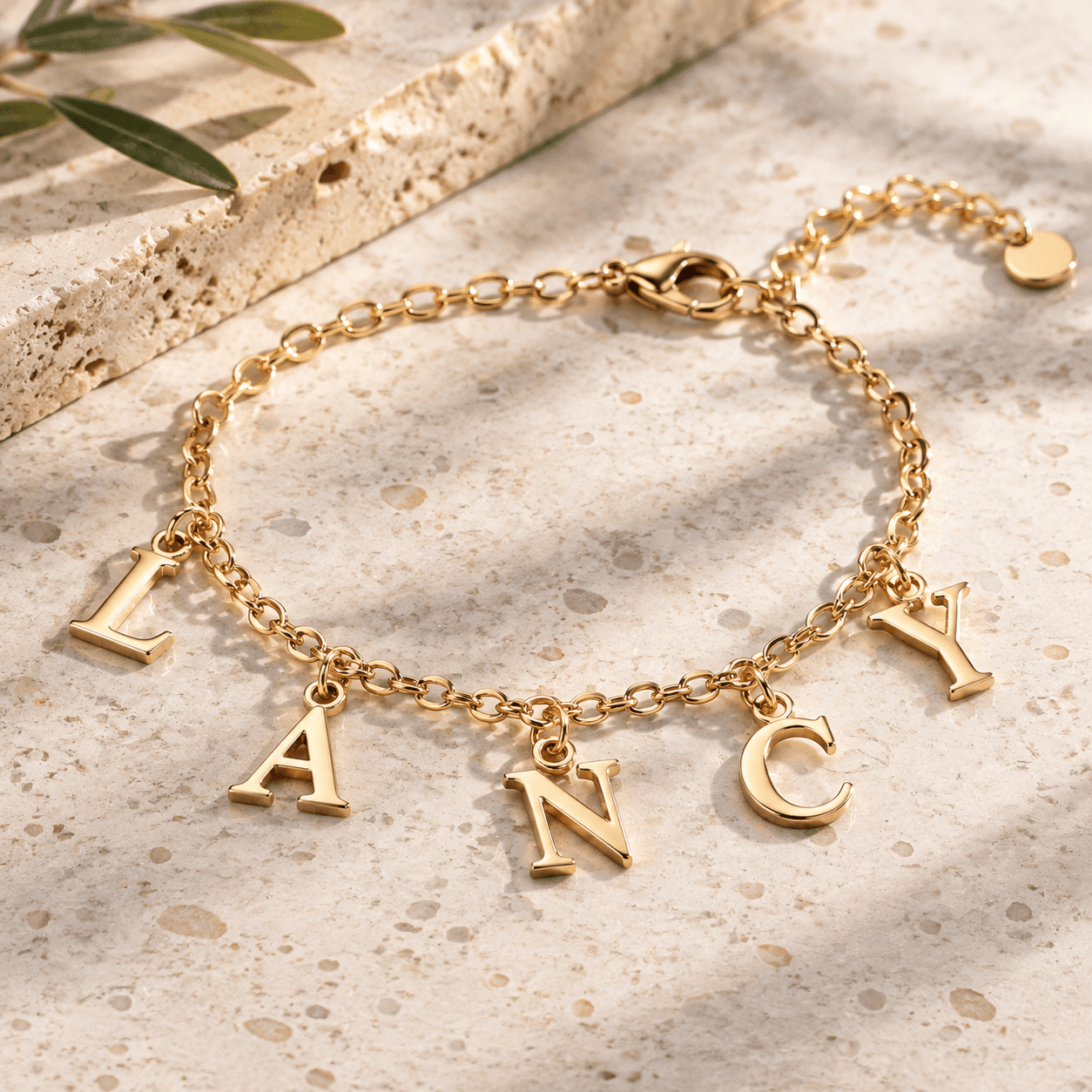
A letter charm bracelet is a versatile way to express identity, celebrate meaningful connections, and create personalized jewelry collections. Initials, monograms, names, and carefully selected decorative details allow jewelry designers to develop distinctive combinations for different customer preferences. Understanding proportion, spacing, finish coordination, and attachment design is essential when planning a visually balanced letter charm bracelet.
This visual styling guide explores practical design approaches using 316L stainless steel charms, including PVD gold plated surfaces, silver finish options, rose gold plating, enamel details, and crystal inlay. It also explains how designers can translate creative concepts into production-ready specifications through sample development and OEM customization. As a stainless steel charms manufacturer, Lancy Jewelry supports boutique brands and private-label buyers with custom design development, logo engraving, consistent finishing, and low MOQ production planning.
Letter Charm Bracelet Styling: Start With a Clear Design Direction
A successful letter charm bracelet begins with a clear visual concept. Before selecting individual initials, define the message, intended wearer, and overall aesthetic. A single initial creates a minimal personal accent, while two or three letters can communicate a name, meaningful date, or family connection. For boutique collections, alphabet charms can also be organized into coordinated groups that allow customers to create personalized combinations without making the assortment difficult to manage.
Step 1: Choose the lettering approach. Block capitals provide a clean and recognizable appearance, while rounded lettering can create a softer visual character. Serif-inspired letter outlines offer a more traditional decorative direction, and simplified geometric lettering works well for contemporary collections. Designers should consider readability at the intended charm dimensions. For most standard applications, a charm size around 8–18 mm provides a useful starting point, although individual letters may require different proportions depending on their shape.
Step 2: Establish the visual hierarchy. Decide whether the initial should be the main focal point or one element within a coordinated charm arrangement. A central letter can be paired with a smaller heart, star, or botanical accent. Avoid overcrowding the bracelet with multiple large elements. Negative space is an important design feature: it allows each charm to remain recognizable and helps the finished composition feel intentional. Explore the alphabet initial collection for ideas when planning a coordinated letter assortment.
Step 3: Plan the attachment structure. A letter charm needs a mechanically appropriate bail or jump ring that passes through a real hole or closed loop. The connector should provide sufficient clearance for movement without making the letter appear disconnected from the bracelet. During prototyping, check the opening diameter, connector thickness, charm orientation, and movement under normal handling. These details affect both appearance and practical usability.
Visual Gallery: Five Letter Charm Bracelet Styling Concepts
Visual planning helps jewelry designers evaluate how different initials, decorative accents, and surface treatments work together. The following five concepts can be used as starting points for collection development, product photography planning, and customer-facing customization options.
1. Minimal Single-Initial Styling
Use one clearly defined letter as the focal point, with a restrained silhouette and polished surface. A silver finish creates a clean, versatile appearance, while PVD gold plating provides a warmer visual direction. Keep surrounding decorative details limited so that the initial remains immediately recognizable. This approach is particularly useful for everyday personalization collections.
2. Personalized Multi-Letter Arrangements
Combine two or three initials with consistent letter heights and carefully controlled spacing. Designers should test the visual rhythm of different letter combinations because narrow letters such as I and wider letters such as M occupy different amounts of space. Custom jump ring placement and bail positioning can help maintain an even arrangement. Consider offering letters individually so customers can assemble meaningful combinations.
3. Initial and Heart Combinations
Pair a letter with a small heart accent to create a coordinated romantic or gift-oriented design. The heart should complement rather than overpower the initial. Matching the finish across both components creates continuity, while a subtle enamel detail can introduce controlled color. The heart collection provides a useful reference for developing coordinated decorative elements.
4. Celestial and Symbol Accents
Combine an initial with a small star, moon, or other symbolic detail. This direction works well for collections organized around personal meaning and visual storytelling. Keep the symbol secondary to the letter and check that the individual components do not collide when the bracelet moves. Designers can explore the special symbols collection for complementary decorative concepts.
5. Birth Month and Personalized Gift Styling
Connect initials with a birth month concept by selecting a coordinating crystal inlay or carefully controlled enamel color. This creates a clear merchandising story for birthdays, celebrations, and personalized gifts. A consistent charm scale and attachment system help the different variations look like part of one collection. See the birthstone collection for additional design directions.
For each concept, prepare front, side, and attachment-detail views. A visual specification should identify the letter shape, dimensions, finish, decorative treatment, and connector position. This makes it easier to evaluate prototypes and maintain consistency across an expanding alphabet range.
316L Stainless Steel, Surface Finishes, and Letter Charm Quality
Material selection directly affects the durability, appearance, and manufacturing consistency of a letter charm bracelet. Lancy Jewelry focuses exclusively on 316L stainless steel charms as the base material. This grade is valued in jewelry manufacturing for its corrosion resistance, mechanical strength, and suitability for detailed decorative components. Its chromium-rich passive surface helps resist oxidation and corrosion under ordinary use conditions. Actual performance still depends on product construction, surface condition, exposure, and maintenance.
PVD gold plating provides a controlled decorative finish through a physical vapor deposition process. During production, the surface is prepared before the coating is deposited under controlled conditions. Adhesion, coating uniformity, and final appearance depend on substrate preparation and process parameters. Silver finish and rose gold plating offer additional visual options for coordinating initials with other charms. When planning a multi-finish collection, specify the target color, gloss level, and acceptable visual variation for each finish.
Enamel color filling introduces a defined color area into selected letter details, while crystal inlay can add a focused decorative highlight. Both techniques require careful dimensional planning. Letter strokes must provide enough space for the intended decorative treatment, and small recesses need to be evaluated for clean filling and finishing. Crystal setting also requires an appropriate seat and secure mechanical retention. These features should be checked on physical samples rather than approved from artwork alone.
Quality evaluation should consider more than appearance. Relevant checks include dimensional consistency, surface scratches, edge finishing, connector security, plating uniformity, enamel coverage, and crystal setting stability. SGS testing and documentation can help buyers assess applicable requirements, including RoHS, REACH, EN1811, and salt spray testing. These references address different compliance or performance questions: RoHS concerns restricted substances in its applicable scope, REACH addresses chemical requirements, EN1811 provides a nickel-release test method for relevant products, and salt spray testing evaluates corrosion behavior under defined laboratory conditions. Buyers should request current reports, identify the tested product and finish, and verify the applicable market requirements. A test report should not be interpreted as automatic certification of every product variation.
For product care, recommend avoiding prolonged exposure to harsh chemicals, storing pieces separately, and cleaning surfaces with a soft cloth. Consistent care instructions help customers maintain the appearance of their personalized jewelry.
Custom Letter Charm Development: From Sketch to Production
Turning a letter charm bracelet concept into a manufacturable collection requires coordination between creative design and technical engineering. An OEM charms manufacturer should be able to evaluate both the appearance of the initial and the functional requirements of the finished component. Lancy Jewelry supports OEM and ODM development for boutique jewelry brands, charm bar retailers, gift companies, and private-label buyers seeking coordinated 316L stainless steel designs.
Step 1: Prepare the design brief. Provide vector artwork when available, reference dimensions, preferred lettering style, finish requirements, and expected usage context. Identify whether the charm is intended for a bracelet, necklace, or another permitted jewelry application. If the design includes enamel, crystal inlay, or a logo, indicate the location and approximate dimensions of each feature. A complete brief reduces uncertainty during technical review.
Step 2: Review manufacturability. The factory evaluates stroke thickness, letter openings, edge geometry, overall dimensions, and attachment points. Some letter shapes require additional structural support to avoid fragile sections. The bail or jump ring must be correctly proportioned and securely connected through a genuine hole or loop. The design team can adjust dimensions while preserving the original visual direction.
Step 3: Develop and evaluate samples. Sample development allows buyers to inspect the actual surface, weight, proportions, attachment movement, and decorative details. Review the physical sample against approved drawings and record any changes clearly. For multi-letter programs, inspect several different letters because their geometry and production characteristics are not identical. A capital A, for example, has different internal openings and balance requirements from a capital O or I.
Step 4: Confirm the production specification. Before bulk charm orders, approve the final artwork, dimensions, base material, finish, decorative details, packaging, and inspection criteria. A written golden sample standard can help establish the agreed appearance for subsequent production. Lancy supports PVD plating, logo engraving, enamel color filling, crystal setting, and private-label packaging to help buyers develop cohesive product programs.
Step 5: Plan the commercial assortment. An alphabet collection can involve 26 separate letter SKUs, so forecasting and inventory management deserve attention. Review likely letter demand, initial combinations, finish variations, and packaging requirements before confirming the MOQ. Low MOQ support can help qualifying buyers test a focused assortment before expanding into additional finishes or decorative treatments. Visit the OEM manufacturing service page to explore custom development options.
Collection Planning, Photography, and Boutique Merchandising
A well-planned letter charm bracelet collection needs a consistent design language across the entire assortment. Instead of treating every letter as an isolated product, create a system that connects dimensions, surface finishes, connector proportions, and packaging. This allows buyers to offer meaningful personalization while maintaining a recognizable product presentation.
Build a Balanced Alphabet Assortment
Start with a complete initial range where commercial requirements justify it, or introduce a focused selection based on customer research. Track individual letter demand and use sales information to plan replenishment. Standardize the attachment structure wherever practical, while allowing the front design to accommodate the natural differences between letters. This reduces unnecessary variation in technical specifications.
Coordinate Finishes and Decorative Features
Choose a core finish and one or two complementary options before introducing additional variations. PVD gold plated, silver finish, and rose gold plating can create distinct visual groupings. Enamel accents can be used selectively to identify themed subsets, while crystal inlay is better reserved for designs with enough surface area to support secure setting. Avoid adding decorative features simply to make every letter different; consistency is often more important for a recognizable collection.
Use a Structured Visual Gallery
For product photography, use a pure white background, centered composition, realistic surface reflections, and complete visibility of the charm silhouette. The bail or jump ring should be visible and mechanically plausible. Include a macro image showing letter edges and surface treatment, along with a scale-reference image using a packaging card or display tray. For lifestyle photography, a premium boutique charm bar scene can demonstrate personalization without distracting from the actual products.
Prepare Retail-Ready Packaging
Private-label packaging should protect individual charms, keep the assortment organized, and make letter identification straightforward. Consider clearly labeled compartments, coordinated display cards, and packaging formats suited to the intended sales channel. For charm bar retailers, an organized display system can help customers locate initials efficiently. For gift companies, consistent packaging presentation can make the assortment easier to merchandise as a coordinated program.
Buyers sourcing through a wholesale stainless steel charms program should also establish inspection expectations, packaging specifications, carton quantities, and reorder procedures. For a complete assortment review, browse all Lancy products and identify complementary categories that fit the intended collection direction.
Frequently Asked Questions About Letter Charm Bracelets
Develop Your Custom Letter Charm Collection With Lancy Jewelry
Ready to develop a personalized letter charm bracelet assortment for your boutique, charm bar, or private-label program? Share your design direction with Lancy Jewelry and receive practical feedback on dimensions, attachment construction, surface finishes, and manufacturing feasibility.
For an accurate RFQ and sample development review, prepare the following information:
- Design files: Alphabet artwork, vector drawings, initial combinations, and any approved logo engraving files.
- Product specifications: Target charm dimensions, thickness, letter style, attachment hole or loop requirements, and intended jewelry application.
- Material and finish: 316L stainless steel base material, PVD gold plating, silver finish, rose gold plating, enamel colors, or crystal inlay requirements.
- Quantity planning: Estimated quantities per letter, total assortment size, requested MOQ, and expected bulk reorder volume.
- Sample requirements: Priority letters for prototyping, sample quantity, preferred evaluation schedule, and any physical references you can provide.
- Packaging and compliance: Private-label packaging requirements, destination market, applicable testing expectations, and requested SGS documentation.
Lancy's OEM and ODM capabilities support the development process from design assessment through sample approval, production planning, finishing, and private-label packaging. Whether you are launching a focused initial collection or planning a larger alphabet program, clear specifications help establish a consistent production standard.
Explore OEM and ODM services, review the product catalog, or submit an RFQ and request a quote. For project discussions and sample coordination, visit the Lancy Jewelry contact page.
Related resources
Related resources
- How to Choose a Stainless Steel Custom Enamel Bracelet Charms Supplier
- Custom OEM/ODM Guide to Stainless Steel African Jewelry Charms Wholesale
- Stainless Steel Interchangeable Charms Jewelry Wholesale: Guide
- Guide to stainless steel jewelry charms wholesale vintage pictures
- Stainless Steel Custom Enamel Charms: A Buyer’s Quality Guide
- Stainless Steel Animal Jewelry Charms Wholesale: Quality Guide
- Stainless Steel Inspirational Jewelry Charms Wholesale Guide
- How to Evaluate Stainless Steel Custom Enamel Charms Suppliers
- 316L Steel Guide to Custom Enamel Charms Manufacturing for Buyers
- 316L Stainless Steel Custom Enamel Sterling Charms: A Buyer’s Guide